Investment in Time

Fishing clubs can be the best way for a new angler to learn about a local fishery. It can be very frustrating when an angler moves to a new area and has to start over. But it is always helpful to find that fishing buddy who can show you the best locations and proven techniques in the new area.

But what do most anglers do when they move into a new area? They wing it. And finally they may stop into a local tackle shop, possibly pick up a new rod and reel set up, package of bait, hit the surf and hope for the best. Good start but still not the answer.
Fishing Clubs

Now they may even use their personal “it worked up north” gear. Some of which was not geared for this type of fishing. There is a good chance they will catch something and possibly have a good time. But once they get past that stage, they may ask themselves, now what? Continue to return to the tackle shop for advice, fish alone or seek out a fishing buddy who can show them the ropes?

Well, that’s where a fishing club comes into play. A fishing club can take that new or even experienced angler to the next level. As with every hobby, using certain techniques that if utilized properly will make the activity more successful and even a lot of fun. And this works the same way with fishing. Make it a habit doing things right and great times will follow.

Joining a fishing club will give those new anglers that competitive edge. And with the access to knowledgeable members and the support and camaraderie found there, the angler will find it to be a win-win proposition.

Membership is not just one sided affair. This commitment in a fishing club takes work. Each member is asked to participate in a number of activities all of which makes the club successful.

There are periodic meetings, assorted committees, picnics, awards dinners and of course tournaments. These all take volunteers to make it happen.  But the rewards are worth the effort.

Most fishing clubs meet monthly sometimes for just a few hours. Typically, there several parts of each meeting: Club business, speaker, committee reports and open forum.

Fishing clubs are the best opportunity for an angler to expand their skill level. It can open many doors typically not usually available to the casual angler.

If you looking for something new and exciting, joining a local fishing club is time worth spent and is definitely worth your effort.

The Outer Banks has several types of fishing clubs looking to add new members. If you are looking for new friendships and a place learn new techniques, then check them out.

A list of many local fishing clubs is available at the Walkingangler.com under the “ASSOCIATIONS/CLUBS” tab

Until Next Time – Tightlines – Capt. Tony
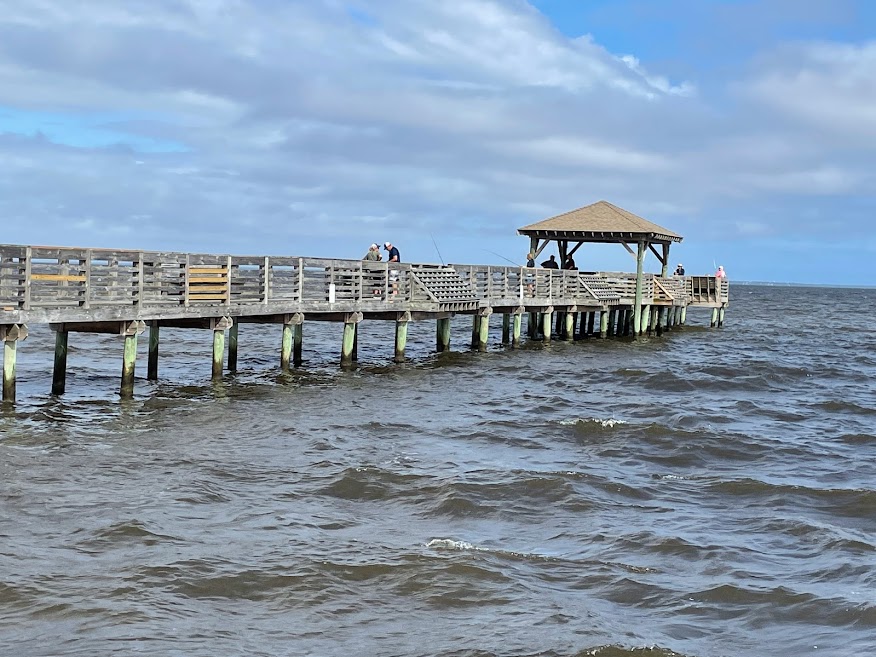
Not So Secret Now

The Bebop Public Multi-purpose pier is sometimes referred to as the “not so secret anymore ” fishing spot. The two hundred foot pier is located at the west span of the William Umstead bridge and sits between the Albermarle Sound to the north and Croatan Sound to the south. The water in this area is on the saltier side of brackish so it can hold many species of both saltwater and freshwater fish. Although this area is not affected by tidal action, vast water surfaces surrounding this pier allow for wind and fast currents to pass around this structure.

Bebop Public Multi-use Pier

This pier was originally the site of an old dock and worn shoreline. It is surrounded by many submerged pilings and cypress knees. Caution should be taken when fishing and casting in these areas to avoid getting snagged. Although many hazards exist, anglers can find productive and snag free spots.

The pier area has ample parking leading to a low-sloped ramp easily accessible for those with limited mobility. Benches, a covered pavilion and many modified railings are designed for easy casting for young and older anglers.

In the warmer months, anglers can find puppy drum, sheepshead and many types of other saltwater bottom fish around the pilings and close to the sandy shoreline. Striped Bass typically show up in the early fall and can be caught by using noisy lures and long casts toward the bridge.

Light to medium should be the gear of choice and should handle most species found at this pier. Either braided or monofiliment lines work fine but either must be tipped with a fluorocarbon leader. Successful anglers should leave their heavy gear in their vehicles.

The best rigging option is a standard double drop rig with either “J” or circle hooks. Another type is a standard Carolina rig with a sliding sinker. Popping corks have been used here but typically not as successful as rigs that place baits near the bottom. To ensure more stealth, metal or shiny rigging components should be kept at a minimum.

Finally, another productive method is using topwater lures or lead head jig with a scented plastic bait. Casting and retrieving should be varied to mimic an injured fish. Strikes occur on the fall or stall phase.

Like the other rigging components, hook size is determined by the type of bait you plan to use. Large hooks and small baits don’t always catch fish – they sometimes spook them from taking the bait. Select your hook size consistent with baits.

Fresh shrimp or cut bait work best at this pier. Never use yesterday’s bait today. Bring plenty because you will share most of it between the crabs and small bait fish. 

At first look, anglers may think this little pier has nothing to offer. But the proximity to both the shore line and the Umstead bridge gives the angler several different opportunities. 

Purple martins call this area home for several months a year, mosquitoes can ruin anyone’s day quickly and crabs can empty your bait supply quickly. So before you go, prepare accordingly.

This pier may appear small but it can make big memories.

Until next time – Tightlines Capt. Tony

Know the Pressure

This past week we heard about the first tropical storm of the season in the Atlantic.  So this is a good time to discuss how weather affects fishing. While there are many weather components that can influence angler’s success, it’s the barometric pressure that has the greatest impact.

Barometric pressure is the amount of force or weight where the atmosphere pushes down at any point on earth and its inhabitants. This pressure can be measured as either rising or falling or steady responding to the current weather conditions. And each one of these three different conditions or readings can have a significant effect on fishing.

Barometric pressure is caused by two or more different weather systems interacting with each other thus we see or even feel a rise or decrease the pressure. This rising and falling typically proceeds or then can follow a weather system or storm. For example, an approaching front or storm will cause the barometric pressure to decrease and once the front or storm passes the system will return back to its normal or steady pressure state. We see this as a typical summer storm passes. And the closer the storm is to a particular area, the lower the pressure can become.

So what does all mean to fishing? So how does this condition effect fishing?

On steady calm or “bluebird” days, fishing is dependent on many natural instincts of a specific species. Fish act in a normal fashion and remain comfortable and feed regularly. As the front begins to approach, many species can sense the approaching storm and the decrease in pressure. They typically will begin to feed aggressively for fear of days ahead where food sources are scattered. Then as the storm is upon them, the decreased pressure pushes heavily on the fish, most specifically their organs, thus causing them to feel full and reducing their instinct to feed and may even cause them to stop all together. Once the front or system passes, the pressure rises and the “full feeling” effect diminishes and the fish become “more comfortable”, the fish will again begin to feed normally.

So what does all this mean to the angler? First, this condition is the angler’s “ace in the hole”.

Anglers should always monitor the barometric pressure and watch for even slight changes. And when a front or storm system approaches or passes by, they should try to be at their favorite spot. It is a well-known fact that fish feed aggressively when they sense these weather changes. And good anglers know to follow this practice and have been rewarded.

Of course, anglers should never take chances or take a risk to be out on the water during lightning, high winds or any type of dangerous weather. It is never safe to be on or near the water when there are stormy conditions.

Looking for one more advantage, why not check the barometric readings on weather page before your next fishing trip. The results just might surprise you.

Until Next Time – Tightlines – Capt. Tony