
The solution to any problem – whether it be work, love, money, whatever – is to go fishing, and the worse the problem, the longer the trip should be.
John Gierach
The solution to any problem – whether it be work, love, money, whatever – is to go fishing, and the worse the problem, the longer the trip should be.
John Gierach
Two of the most guarded secrets an angler keeps is their favorite fishing spot and the contents of their tackle bag. While secret fishing spots are frequently shared only to close friends, their tackle bags contents can be held stealth for years.
To guard that secret, most anglers will quickly retrieve gear from their bags away from spying eyes. It’s probably no secret to the contents of a typical tackle bag but serious anglers can be a little funny on their favorite and probably the most reliable lures and techniques.
The tackle bag, as a general rule, should only include items you will need on the current fishing trip. But lots of anglers, including this author, use the bag sometimes as a storage box for everything they possibly could ever use even if it doesn’t work on every trip. While a great place to store gear when not in use it’s especially not one to drag out on each trip.
Tackle bag contents will vary depending on the target species and fishing location.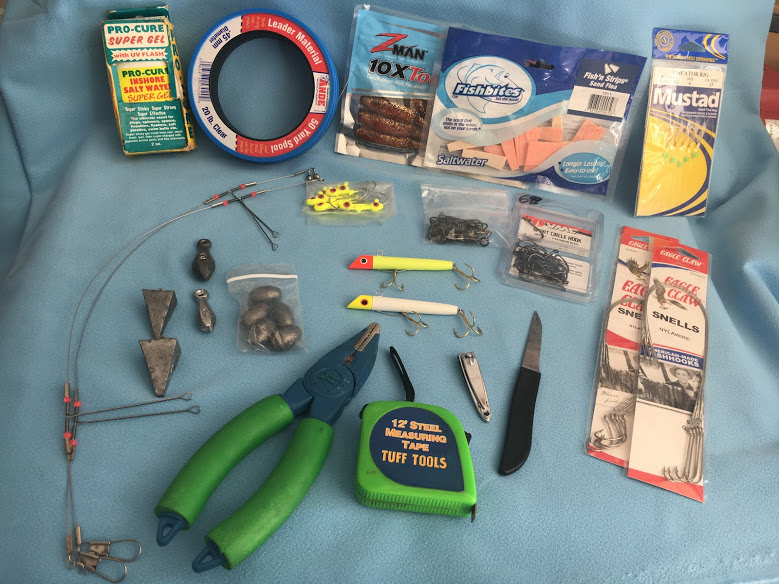
Standard contents should at least include a collection of sinkers, hooks and terminal rigging gear.
Also several types of two hook bottom rigs, Carolina rig and several self-made or purchased bottom or pompano rigs are needed for those special occasions. Sabiki rigs are great for catching your own live bait.
Anglers should also carry a small bait knife, cutting board, finger nail clippers, and pliers, tape measure, and fish grippers. Several rags will help steady a fish to remove hooks – but remember, if holding a fish with a rag make sure it’s wet. Dry rags can wipe the protective slim off a wiggling fish quickly.
The bag should also include a variety jigging gear with a variety of lead heads, various soft swim baits, and several different got-cha plugs or top water hard baits. A bottle of attractant will help enhance the artificial to smell similar to real bait fish.
A tackle bag with not be complete without “fish-bites” or some type of artificial baits.
This list is definitely not complete and inclusive but it should give the new or occasional angler as least a start on filing that tackle bag with basic gear.
Of course, there is always time to load it so full of the angler’s special and most reliable gear, which like the author, can act more like a storage bin than a tackle bag.
One tip: Put extra gear that will not be used that day in a rubber-made crate in your vehicle. That way, the gear won’t load down you bag but if needed it’s just a quick walk back to your vehicle.
Until next time – Tightlines. Capt. Tony
Fifth in a Series – The hook up when fishing from the surf can be tricky. There are several key steps that the new angler should keep in mind when fishing from the surf.
It’s all about your sense of touch. When fishing the surf, wave movement and debris can mimic a fish bite. Water movement can pull your bait along as can grass or other debris and sometimes this debris or current can simulate a bump or even a bite.
A bite is a distinct single or repeated “bump bump bump”. It could even be a slight pull and pause then pull again. The ability to distinguish between something floating by and a bump and bite can take time but it’s a lesson well learned.
If you can’t tell if it’s a bite or not, leave the line in the water for several minutes and then check your hook and bait.
Setting the hook is the next important part of the catch. And setting the hook improperly can mean the difference of catching or losing the fish. There are many different ways to set the hook. And regardless of your experience level, you need to learn which works for the fish you’re after.
There are two common types of hooks used for surf fishing: “J” hooks and “circle” hooks.
If you are using “J” hooks, you must give a firm pull on the line to pull the hook through the fish lip. Pull too soft, they may spit the hook after they strip the bait, pull too hard, you pull the hook and bait away before they can suck it in.
The best bet for new anglers is to use “circle hooks”. These hooks do all the work for you and the fish actually hooks themselves. (see picture – I am using a circle hook)
Remember, for some fish a heavy pull up on the rod sets the hook: for others, a hard pull yanks the bait from the fish’s mouth.
Next we will discuss the retrieval of a hooked up fish.
Until next time – Tightlines – Capt. Tony