Tides Do Matter

We have talked tides several times over the years and this is a great time to refresh. Tides can have a major influence on whether you catch fish or not. It’s the various tides that help create ideal conditions for fish to feed. And if the angler is present during these feeding times, their chances improve significantly.
It’s been a common practice that most anglers prefer to fish on top of the high or low tides. Frequently, anglers will also look to fish on the sun and moon phases  but it’s actually the tides that should bring the anglers out. But it’s the specific part of these tides that make all the difference.

Let’s take a closer look at why you too should consider following the tides.

Ocean tides occur up to four times per twenty-four hour period – two high and two low. The tide phases are influenced by a number of conditions but mostly the moon.  Frequently, we hear that it’s best to fish on the exact full or new moon or on the top of the high or low tide because in theory that’s when the bite is on.

Well, this is only partially correct. Let’s take a closer look at how the tides affect the bite.

First, a little background – when the high and low tide are at their peaks, the water is slack and not moving unless there is outside influence such as wind. And second, when the tide is between the high and low, this is where a significant water movement can occur between the two tide phases.

Now, let’s break down one side of a tide. At the highest phase of high tide the water is slack. As the tide begins to fall, water starts to move toward the low tide phase. As the level continues to fall, this tide or water begins to pick up speed until it reaches a certain point usually two thirds into this phase at which the water begins to slow again to a slack phase.  Then the process starts again but in reverse.

So let’s do an example to help find the best time to fish. Let’s start with high tide at 600am and the low tide at 1200 noon. The tide is slack at 600 and with gravitational influence the water level or tide begins to fall. As the tide continues to fall, it will pick up speed typically around 0730 and continue to increase flow or speed until 1030. At this point the tide begins to lose its force and between 1030 and 1200 noon the tide slows and finally is slack again.

As you can see in this example, the fastest moving water and the best times to fish is approximately 1-1/2 hours after high and before low tide. Other times work too, but for increased success pick these.

Remember, there are many other conditions that can influence the bite. Water movement is just one. Monitoring water temperature, seasonal migration and barometer can also improve your success.

But reviewing tide phase should always be part of your fishing trip preparation.

So the next time you pick up a local tide chart – do some homework and you might just catch some more fish.

Until next time – Tightlines – Capt. Tony  

Let’s try Fishing – “Reading the Surf”

Reading the Beach is part five in the series, “Let’s Try Fishing”. In this step we try to help the new angler to find the right location that will hold fish. Most experienced anglers should have a good idea where to find fish but this could be a good refresher.

The question was “how does a new angler find a good spot to fish on the surf”. Of course, the new angler can just pick any place and cast a line and hope for the best. But following this strategy, their success is hinged more by luck than anything else.

Reading the Surf

The key for success on the surf is to look for the signs. It is important to keep in mind that the signs that you first see when arriving at the surf can change by the hour or even half day. So a constant awareness of conditions is imperative for putting you in the right spot.

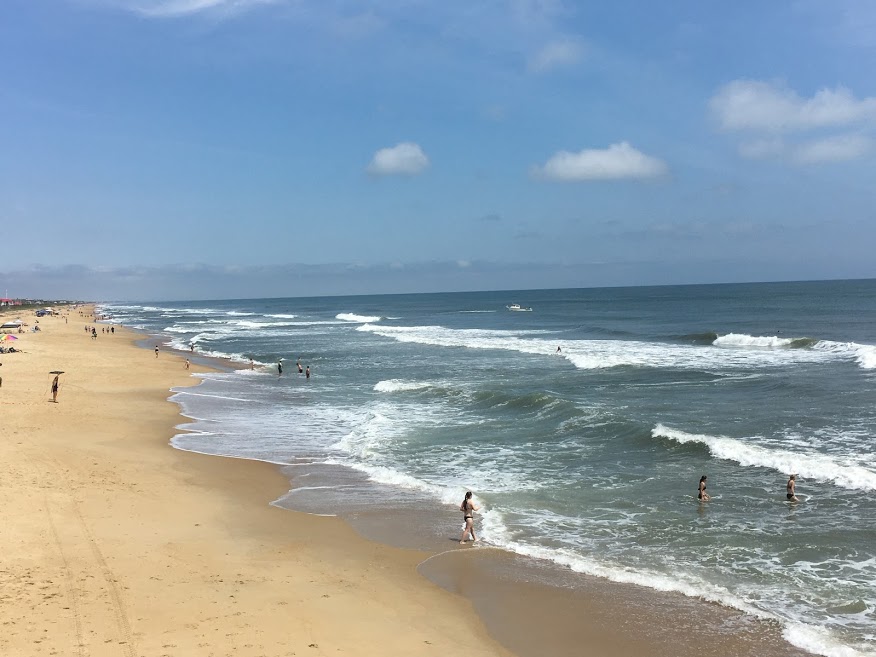
When hitting the beach for the first time, anglers should first focus on the entire picture. Look at everything in the surf zone but more specifically focus on sand formations and waves.

Flat sand beaches can indicate shallow water. On the beach where the sand tapers from a flat surface into the water will indicate a gradual slope. This area will be shallow for some distance off shore and rarely hold fish.

Some sand formations that include cusps or small hills could indicate a greater slope and deeper water. The deeper water close to shore is better at holding for fish. One key here is look for gravel and shells. Also, look for the signs of sand fleas – that telltale “V” shape in the sand after a retreating wave is a guarantee give away.

Wave action will also give out specific signs. Normally waves form off shore and travel a good distance in and break on the surf. This is a sign that the bottom has a gradual slope for most of the wave set.

The best condition is when the waves break off shore on a bar, taper off and then re-form and break again on the shore. This is a good indication of a slough. Sloughs form between a sand bar and a steep sloping beach. The slough is where most of the fish will be found.

A slough is a channel of moving water that flows parallel along the beach and provides a highway for fish to find food and protection from other prey. This is the best place to find fish.

The final sign is a rip current. A rip current is a rapid outflow channel or river of water. This happens when the waves push too much water onto the beach and there needs to be a way for the excess of water to flow back out to sea. They are easy to spot, look for the rapid out flow current.

So when looking for the best place to fish on the surf, focus on the sloughs, deeper water and rip currents. Remember most fish are within ten feet of your feet. So keep your bait close.

Knowing when and how to fish the surf can make the difference. Next, the presentations and catching fish.

Until next time – Tightlines – Capt. Tony