Did They See You

It happens more frequently than not. You approach your favorite spot. The spot you always catch fish at but today you get skunked. You know the fish are always there but now they have disappeared. Where did they go?

Well, maybe they are still there but they saw or heard you before you saw them? In most cases, your presence spooked and scattered them. So how to prevent this from happening next time?

There is a child’s game called hide and seek. This popular kid’s game is where the kids attempt to conceal themselves from being seen or heard. The goal of the game is to be the last player found.

Even though they are not aware of it, anglers frequently use the same skills of hide and seek. An angler who stands out on a bridge or shoreline with bright clothing, erratic movements or makes noise not natural to the area is sure to spook an already skittish target. So being stealth is the ticket for improved success.

Most targeted fish have tremendous eyesight and other senses that will warn them that danger is close. Anglers should keep this in mind when planning their next fishing trip, selecting a location or even what prey they plan to target.

Clothing is the first line of hide and seek. Wearing a contrasting shirt color against either a bright or cloudy day can warn the fish that some type of danger is present. So anglers should try to avoid standing out or causing a shadow against the background.

camouflaged with the rocks

A good rule is “If the sky is a bright blue, your shirt color should blue”. Similarly, if there is an overcast day, your shirt color should match as close to the background as possible. In this case, your clothing could be pale or light grey.

But what about partly sunny or clouds, colors should be neutral or natural. The best rule to follow is use only colors that are not bright or result in the angler to standing out.

Erratic angler movement can also influence a targeted prey to flee. When fishing on a bank or other structure, the angler’s movement is probably just as important as camouflage clothing. Trees or other vertical structures do not move erratically unless there is wind or significant weather condition.

Fish can sense the surrounding weather conditions including wave action, wind and other environmental influences, so they will know what is unnatural. Anglers should limit their movement to a minimum.

Unnatural noise and sounds are also a component of being stealth. Loud voices and talking, haphazard placement of gear, dropping or banging of objects should be kept at a minimum.

Basically, any noise and unusual sounds that are not typically found in a specific location, or other similar noises put up a warning to our target. Even low level voices or placement of gear can be felt or heard for quite a distance both through the air and water.

Being stealth and using good camouflaging techniques will give you a significant advantage. Smart anglers consider these techniques as well as many others when trying to avoid being detected.

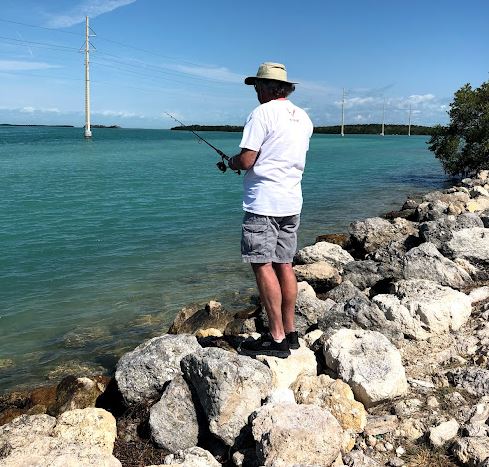
If you notice in the attached photo, the anglers clothes match the surroundings.

So next time you visit your favorite spot, be stealth, it might just help improve your catches.

Until next time – Tightlines. Capt. Tony

Let’s try Fishing – “Reading the Surf”

Reading the Beach is part five in the series, “Let’s Try Fishing”. In this step we try to help the new angler to find the right location that will hold fish. Most experienced anglers should have a good idea where to find fish but this could be a good refresher.

The question was “how does a new angler find a good spot to fish on the surf”. Of course, the new angler can just pick any place and cast a line and hope for the best. But following this strategy, their success is hinged more by luck than anything else.

Reading the Surf

The key for success on the surf is to look for the signs. It is important to keep in mind that the signs that you first see when arriving at the surf can change by the hour or even half day. So a constant awareness of conditions is imperative for putting you in the right spot.

When hitting the beach for the first time, anglers should first focus on the entire picture. Look at everything in the surf zone but more specifically focus on sand formations and waves.

Flat sand beaches can indicate shallow water. On the beach where the sand tapers from a flat surface into the water will indicate a gradual slope. This area will be shallow for some distance off shore and rarely hold fish.

Some sand formations that include cusps or small hills could indicate a greater slope and deeper water. The deeper water close to shore is better at holding for fish. One key here is look for gravel and shells. Also, look for the signs of sand fleas – that telltale “V” shape in the sand after a retreating wave is a guarantee give away.

Wave action will also give out specific signs. Normally waves form off shore and travel a good distance in and break on the surf. This is a sign that the bottom has a gradual slope for most of the wave set.

The best condition is when the waves break off shore on a bar, taper off and then re-form and break again on the shore. This is a good indication of a slough. Sloughs form between a sand bar and a steep sloping beach. The slough is where most of the fish will be found.

A slough is a channel of moving water that flows parallel along the beach and provides a highway for fish to find food and protection from other prey. This is the best place to find fish.

The final sign is a rip current. A rip current is a rapid outflow channel or river of water. This happens when the waves push too much water onto the beach and there needs to be a way for the excess of water to flow back out to sea. They are easy to spot, look for the rapid out flow current.

So when looking for the best place to fish on the surf, focus on the sloughs, deeper water and rip currents. Remember most fish are within ten feet of your feet. So keep your bait close.

Knowing when and how to fish the surf can make the difference. Next, the presentations and catching fish.

Until next time – Tightlines – Capt. Tony

Fishing – Is It Better to Fish Early or Late

Historically, it has been the experience among anglers that it’s better to fish before breakfast or after dinner. Whether this preference is based on experience or theory, is anybody’s guess. But there are many reasons why anglers would prefer these times opposed to others.

It could be the cooler conditions or possibly the outdoor experience or it could be that the fish actually bite better during those times. Who knows, but there are several theories that could tell the story. So let’s explore several.

There is definitely a big difference between fishing dawn and dusk verses day time. Coolness verse the heat of the day. Sunrises and sunsets, various moon phases, cooler air and water temperatures along with the amount of light striking the water all can contribute to a change in feeding habits.

The sun has always had an effect on fishing. On bright days with the sun directly overhead seems to chase the fish deep in the water and slows their metabolism. On the other hand, low light and cloudy days seem to turn the bite on.

At dawn and dusk, the sun rays can be at a sharper angle to the water. This angle allows for lower light to penetrate the water and enhances the sight of various marine species. The lower light conditions can give feeding species an advantage finding food or the bait quickly because of their light sensitive eyes.

The moon phases can also affect the movement and height of the tides but more importantly this water movement can confuse many bait fish.  And this water movement can also bring in a change in more comfortable water temperatures.

Another theory is the amount of oxygen content in the water. Cooler water contains more oxygen then warmer water. So it’s natural that fish find comfort in these cooler conditions and tend to feed more.

At dusk, the air temperature will usually drop. The cooler air causes the water temperatures to also decrease slightly. This cooling trend creates a desirable environment for most species Small living organisms and bait fish are extremely active during these times and make for easy prey of the larger fish. So with more activity brings an increase in the possible success rate.

At dawn, the air temperatures begin to increase with the sun rise. The water temperatures will also increase. Even though it might be slight, the fish seem to sense this change and typically will begin to feed aggressively during this period being aware that their feeding cycle may end soon.  As the temperature continues to rise into the morning and dawn turns into day, this change causes the fish and their prey to slow down considerably and seek deeper cooler waters again.

Obviously, these are only couple of theories on why fish feed more aggressively during these times. There could many other conditions and reasons why fish are more active at dawn and dusk.  

Regardless of the reasons, anglers will continue to look forward to that “before breakfast and after dinner bite”.

So now the next question based on the facts, “will you try your luck at dusk or dawn too”?

Until Next Time – Tightlines – Capt. Tony